Connected Domain
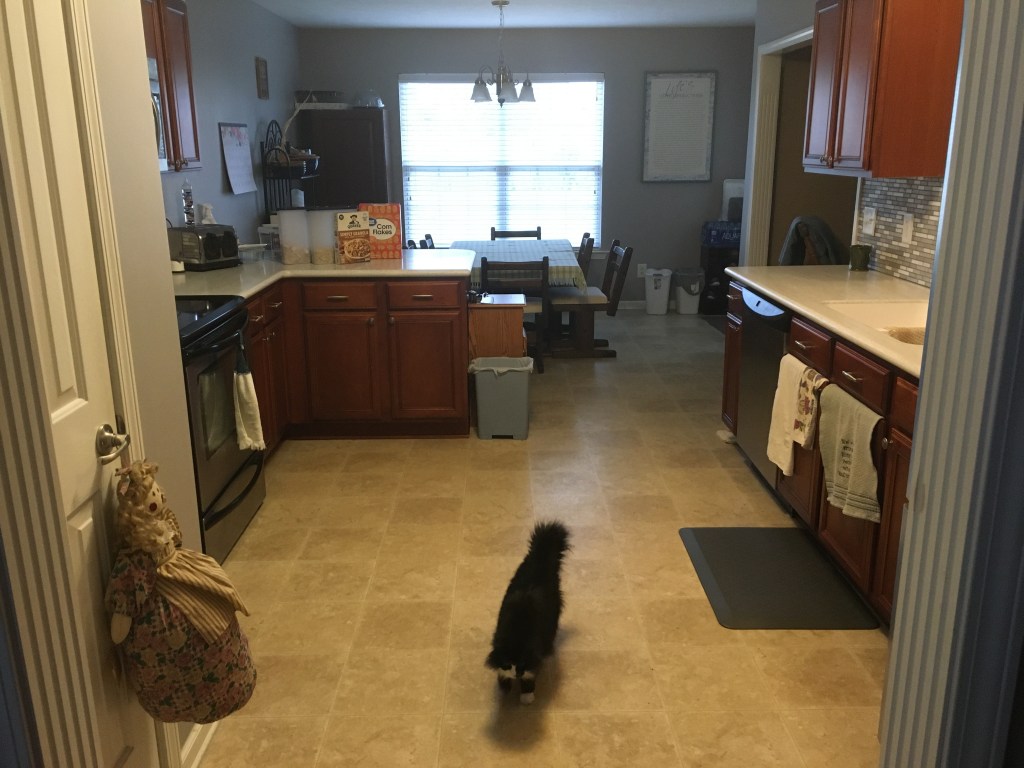
This is my kitchen. It is seen here from the perspective of one standing in the formal dining room, looking through to the window facing the backyard. If one were to peer around just a bit to the right, the large opening seen just beyond the edge of the counter connects to the living room. The L-shaped countertop on the left side juts out into what is nearly the middle of the room, serving as both a miniature bar to those seated on its far side, as well as a mental indicator of the division between “kitchen” and “dining room.” The hanging light fixture over the table seems to reinforce this idea of the two areas somehow being separated with only the gap between the trash-can and the left cabinets acting as a “doorway” to the kitchen. If one were to enter from the living room, they would be faced with a choice as the result of this perceived separation; either enter the dining room or the kitchen, right or left. Even though there is a perceived separation, this division doesn’t keep a conversation from happening between the two ‘rooms.’ In fact, this a more of a common gathering place than the living room is from my experience in this house. One might be found leaning over the mini bar to converse with those at the table on its other side, or vice-verse with someone at the stove. Or, one or two may gather near the living room’s opening to pivot their conversation between those at the table and someone at the sink. I personally like to lean back in the corner of the L-shaped counter while my mother cooks and my father is working at the table. The room has this perceived division while also availing itself to the many connections to be made between the two areas. Just as the “Empire State Building has a lot to tell us about capitalism and urban land values in the 20th century,” this domain has a lot to tell us about the family and connections made in a common gathering space.
 Ife's 212 Understanding Architecture Section